I wanted to write this blog not just because it would work as my senior project, but because languages themselves interest me. I grew up in the Southwest, where it was normal to learn Spanish while in elementary school. In my hometown, a good portion of the signs were in Spanish, with it being heard on the streets constantly.
In High School I took more Spanish classes to gain a larger vocabulary, and continued in College to expand my conversational Spanish. When I served my mission in Russia, I obviously learned the Russian language, but at the time forgot my Spanish. As soon as I stepped off the plane from Moscow into Houston, the Spanish came flooding back to me. Since then I have used both Spanish and Russian to land me jobs, or get me a raise.
When I first started attending BYU-I, my plan was to do International Studies and become a translator one day. Yet over my time there, it felt like the only options I had with a language were in Government (which I would rather not work for) or Business (which I wouldn't want to do cause I hate office work). I knew that there were other jobs out there, in the US, that needed someone with Russian and/or Spanish skills. I wanted to create this blog to show that when someone knows a language, even a super rare one that nobody else has even heard of, that there are several career opportunities out there, not just in straight translation work.
I hope that this website will help others get started on their path to finding a career that uses ALL of their skills, not just the ones taught in a formal classroom.
Saturday, April 1, 2017

Tuesday, March 28, 2017
English
History of the English Language

Middle English extends from the 12th Century through the 15th. This came about due to the fall of the Anglo-Saxon rulers of England falling to Norman French invaders, who were led by William the Conqueror. Throughout this period, French was a heavy influence on the vocabulary, causing a loss of some inflections, as well as other changes taking place within the grammatical systems of English (Help, 2017). The heavy influence of French , the roots of Latin, and a portion of German were the greatest changes of the language at this time (Linguistics, 2017).
Modern English extend from the 16th Century AD to the current time period. With the development of the printing press spelling began to stabilize (Help, 2017). This is when pronunciation of most of the vowels changed, an era also known as the Great Vowel Shift. Latin and Greek had their influences on the language, but around this period English becomes the new language that is taught in schools. When the British were working on conquering and colonizing the world, they took their language with them, which heavily influenced the language and pronunciations as well (Linguistics, 2017).
Where in the World is English Spoken?
Four nation-states have English as the de facto official language Australia, New Zealand, United Kingdom and the United States.
 Other nations that have English as an official primary language are as follows: Antigua, Barbuda, Bahamas, Barbados, Belize, Canada, Cook Islands, Dominica, Ghana, Grenada, Guyana, Ireland, Jamaica, Nigeria, Saint Kitts and Nevis, Saint Vincent and the Grenadines, Sierra Leon, Singapore, Trinidad and Tobago.
Then the rest of the English nations have English as the language of Government and Business: Botswana, Burundi, Cameroon, Federated States of Micronesia, Fiji, Gambia, India, Kenya, Kiribati, Lesotho, Liberia, Malawi, Malta, Marshall Islands, Namibia, Nauru, Niue, Pakistan, Palau, Philippines, Rwanda, Saint Lucia, Samoa, Seychelles, Solomon Islands, South Africa, South Sudan, Sudan, Swaziland, Tanzania, Tonga, Tuvalu, Uganda, Vanuatu, Zambia, and Zimbabwe

Countries in which English is the first language of the majority of the population.
Countries with substantial numbers of English speakers, in most cases dating back to the British Empire.[a]
Countries with substantial numbers of English speakers, in most cases dating back to the British Empire.[a]
Finding English to be so widely spoken, it is often referred to as the "world language" of the modern era. Although it is not an official language in most nations, it is found to be taught the most as a foreign language. Due to international treaties, it is the official language for aeronautics and maritime communications. Being an official language of the UN, and also the Olympics, it is easy to find speakers of the English language. Within the European Union itself it is studied the most due to it being considered the most useful of foreign languages.
English has dominated the world, with every piece of literature, from a book to a newspaper to a magazine being translated at the very least into English, even scientific reports being written in English. Unfortunately due to the large impact that English has upon the modern world, languages have shifted in meaning including English itself and there has even been "language death."
(English-speaking world, 2017)

Resources
"Help." Merriam-Webster. Accessed March 28, 2017. https://www.merriam-webster.com/help/faq-history.
"Linguistics 201: History of English Language Handout." Linguistics 201: History of English Language Handout. Accessed March 28, 2017. http://pandora.cii.wwu.edu/vajda/ling201/test3materials/HistoryEnglishHANDOUT.htm.
"English-speaking world." Wikipedia. March 21, 2017. Accessed March 28, 2017. https://en.wikipedia.org/wiki/English-speaking_world.
"List of territorial entities where English is an official language." Wikipedia. March 28, 2017. Accessed March 28, 2017. https://en.wikipedia.org/wiki/List_of_territorial_entities_where_English_is_an_official_language.
"Wooden wall with British flag." Shutterstock.com. Accessed March 29, 2017. https://www.shutterstock.com/image-photo/wooden-wall-british-flag-114403456.
"Shutterstock Official Logo." American Flag Stock Images, Royalty-Free Images & Vectors | Shutterstock. Accessed March 29, 2017. https://www.shutterstock.com/search/american flag.
English.alarabiya.net. Accessed March 29, 2017. http://english.alarabiya.net/en/News/middle-east/2017/03/17/UN-chief-wants-report-on-apartheid-Israel-taken-off-web.html.
Monday, March 27, 2017
Spanish
Spanish - Español
History of the Spanish Language - Historia del idioma español
 Originating in Southwest Europe, now known as the Iberian Peninsula, the regions first inhabitants began to mingle with the Celts at the end of the 6th Century BC. These two groups then formed a group called the Celtiberians, speaking a form of Celtic. When the Romans took over the region, it became known as Hispania, and its inhabitants were to learn Latin in order to deal with Roman traders,administrators, settlers, and soldiers. When classical Latin mixed with the language of the Celtiberians, Vulgar Latin came about. Although it followed the basics of Latin, this new language borrowed several words from other languages.
 Even after Germanic tribes invaded Hispanis in the 5th Century AD, Latin continued as the official language of the government and the culture until roughly 719 AD when Arabic- speaking Islamic groups, the Moors, from Northern Africa conquered the region. Arabic and its cousin Mozarabic spread throughout the region, taking over almost everywhere. Eventually the Christian Kingdoms in the region that survived the conquest, retook Moorish Spain, bringing back their Vulgar Latin and making it a part of the political, military, and cultural worlds. Vulgar Latin and its various dialects then spread as Christians began to move South.
Castilian was a dialect that originated on the North Central plains and was carried South and East. Castilian borrowed several words from Mozarabic, producing modern Spanish which has roughly 4000 words that have Arabic roots. Based on the Castilian dialect, King Alfonso X in the 13th Century began a standardized from of Spanish. Scholars wrote their original works in Castilian, and soon other works were translated into Castilian. Alfonso X himself used Castilian for administrative work, including all official documents and decrees.
 During the reign of the Catholic monarchs, Isabella of Castile and Ferdinand of Aragon, the Castilian dialect of Spanish was wider accepted. Ferdinand finished the reconquest of Spain in 1492, pushing out the Moors. It was then that Isabella and Ferdinand made Castilian the official language of the kingdom. Soon afterwards Antonio de Nebrija's book The Art of the Castilian Language appeared, becoming the first book that attempted to define the grammar of the Castilian language. The Castilian dialect then became the written and educational standard in Spain.
Starting in the 1400s, explorers, conquistadors, and colonizers from Spain traveled to Central, South, and parts of North America, taking their language and culture with them. Castilian was used in cultural centers such as Mexico City, Potosi, and Lima. These cities were closely linked to Madrid, but there was also the dialect of Andalusian. Many people from Andalucia explored as well, taking their dialect with them. This dialect became dominant in Argentina and Central America. These regions were remote, removed from the influence of Spain, cause the Spanish government to lose control. In the 1800's the colonies in America were lost, but the Spanish language stayed.
(Accredited, 2017)
Where in the World can Spanish be found - Donde se habla español
With 21 nations that have Spanish as an official language, it is easy to find spanish-speakers in the Americas and parts of Europe. Looking at only native speakers, about 400 million people are native Spanish-speakers, making it the 2nd most common language in the world.
Starting alphabetically, Spanish is found in Argentina, Bolivia, Chile, Colombia, Costa Rica, Cuba, Dominican Republic, Ecuador, El Salvador, Equatorial Guinea, Guatemala, Honduras, Mexico, Nicaragua, Panama, Paraguay, Peru, Puerto Rico, Spain, Uruguay, and Venezuela.
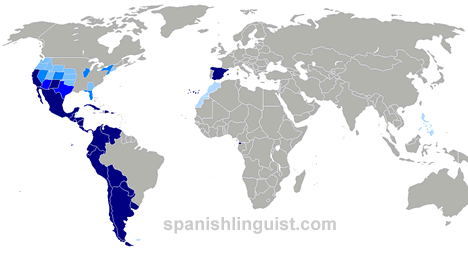
Due to the proliferation of the Spanish language in the US, being the 2nd most common language, it is a benefit to know Spanish when looking for literally any job or position. Spanish is so common in the US that some towns have more signs in Spanish then they do in English.
Resources
Accredited. "Spanish." Accredited Language Services. Accessed March 27, 2017. https://www.alsintl.com/resources/languages/Spanish/.
GmbH, Lesson Nine, and Babbel.com. "The 10 Most Spoken Languages in the World." The Babbel Magazine. Accessed March 27, 2017. https://www.babbel.com/en/magazine/the-10-most-spoken-languages-in-the-world.
Beus, Jake. "Learn." LearnALanguage.com. October 4, 2012. Accessed March 27, 2017. http://www.learnalanguage.com/blog/spanish-speaking-countries/.
"Espana - Spain spanish text - vintage card - poster vector illustration, spanish flag colors, grunge effects can be easily removed." Shutterstock.com. Accessed March 27, 2017. https://www.shutterstock.com/image-vector/espana-spain-spanish-text-vintage-card-303945407.
"List of Spanish-speaking Countries by Population." Spanish Linguist. Accessed March 27, 2017. http://www.spanishlinguist.com/extra/spanish_speaking_countries_world_figures_and_map.html.
Tuesday, March 21, 2017
Portuguese
Portuguese - Português
History of Portuguese - História da língua portuguesa
Developed in the western part of the Iberian Peninsula, Portuguese was born. It was derived from the Latin that the Roman Soldiers brought over to the region in the 3rd Century BC. During the 5th Century Portuguese began to differentiate from other Romance languages after the fall of the Roman Empire. Its use in written documents can be found around the 9th Century, but this was a variant between vulgar Latin and the modern Romance languages, such as Portuguese, Castilian, Spanish, etc. At the turn of the 15th Century Portuguese had suddenly become a language boasting a richness of literature.
At the fall of the Roman Empire, the Iberian Peninsula was invaded by natives of Germanic origin, those which the Romans had labeled as "Barbarians". These Barbarians quickly adopted the Roman culture and language of the peninsula as their own, spreading Vulgar Latin amongst themselves. Speaking different forms of Latin, this lead to the creation of many different languages such as Catalan, medieval Spanish, Galician-Portuguese, and Portuguese itself. The heaviest influence seen from the Germanic languages is in some Portuguese words dealing with war and violence, such as guerra.
Another influence into the languages of the regions came from the 711 AD invasion of the Iberian Peninsula by the Moors, bringing with them Arabic. The Moors were soon kicked out and their Arabian influence on the language almost but disappeared with them.
Once Portugal began its colonial expansion into Africa, some of the countries adopted Portuguese as the official language. Portuguese soon became the language for education, media, administration, and dealings with those outside of the region.
Down in Brazil the story of the language is much like that of original Portuguese itself. There was a strong influence by the Indians that brought in the Tupi language. It wasn't until the second half of the 18th Century that Brazil started to boast a proficiency with the Portuguese language. It was only restricted by the linguistic and cultural policy decreed by the Marquis of Pombal. Portuguese eventually dominated the other languages in popularity, but not before many cultural and native influences of the indigenous people.
Arriving in Brazil in 1500, Pedro Alvares Cabral brought the Portuguese language with him that was originally only found in Europe. At first understanding and communicating with the natives was difficult, but after gaining favor of the natives over that of the Spaniards, Portuguese was able to prevail in popularity. The presence of the Jesuits also had a strong influence on how communications were handled. It wasn't until May 1757 that the Marquis of Pombal declared The Law Directory, which outlawed the Tupi Language.

Developed in the western part of the Iberian Peninsula, Portuguese was born. It was derived from the Latin that the Roman Soldiers brought over to the region in the 3rd Century BC. During the 5th Century Portuguese began to differentiate from other Romance languages after the fall of the Roman Empire. Its use in written documents can be found around the 9th Century, but this was a variant between vulgar Latin and the modern Romance languages, such as Portuguese, Castilian, Spanish, etc. At the turn of the 15th Century Portuguese had suddenly become a language boasting a richness of literature.
At the fall of the Roman Empire, the Iberian Peninsula was invaded by natives of Germanic origin, those which the Romans had labeled as "Barbarians". These Barbarians quickly adopted the Roman culture and language of the peninsula as their own, spreading Vulgar Latin amongst themselves. Speaking different forms of Latin, this lead to the creation of many different languages such as Catalan, medieval Spanish, Galician-Portuguese, and Portuguese itself. The heaviest influence seen from the Germanic languages is in some Portuguese words dealing with war and violence, such as guerra.
Another influence into the languages of the regions came from the 711 AD invasion of the Iberian Peninsula by the Moors, bringing with them Arabic. The Moors were soon kicked out and their Arabian influence on the language almost but disappeared with them.
Once Portugal began its colonial expansion into Africa, some of the countries adopted Portuguese as the official language. Portuguese soon became the language for education, media, administration, and dealings with those outside of the region.
Down in Brazil the story of the language is much like that of original Portuguese itself. There was a strong influence by the Indians that brought in the Tupi language. It wasn't until the second half of the 18th Century that Brazil started to boast a proficiency with the Portuguese language. It was only restricted by the linguistic and cultural policy decreed by the Marquis of Pombal. Portuguese eventually dominated the other languages in popularity, but not before many cultural and native influences of the indigenous people.
Arriving in Brazil in 1500, Pedro Alvares Cabral brought the Portuguese language with him that was originally only found in Europe. At first understanding and communicating with the natives was difficult, but after gaining favor of the natives over that of the Spaniards, Portuguese was able to prevail in popularity. The presence of the Jesuits also had a strong influence on how communications were handled. It wasn't until May 1757 that the Marquis of Pombal declared The Law Directory, which outlawed the Tupi Language.
(The History of the Portuguese Language, 2017)
Where in the world can Portuguese be found - Onde é o Português?
Portuguese is an official language in Portugal, Brazil, Mozambique, Angola, Guinea-Bissau, East Timor, Equatorial Guinea, Macau, Cape Verde, and Sao Tome and Principe.
Portuguese is also used as a working language for business and government in Uruguay, Argentina, Paraguay, Venezuela, Bolivia, Bermuda, Senegal, Namibia, South Africa, Zambia, Goa, and parts of Spain. (List of Territorial entities where Portuguese is an Official Language, 2017)
Global spread of Portuguese.
Native language
Official and administrative language
Cultural or secondary language
Portuguese-speaking minorities
Portuguese-based creole
Where in the US do Portuguese speakers live - Estados Unidos da America
Portuguese can be found in high concentrations in these following states and cities.
Florida: Miami, Wacissa, Copeland, Hurlburt, Loch Lomond, Avalon, Mexico Beach, Bonnie Lock- Woodsetter North, Deerfield Beach
New York: New York City
Massachusetts: Boston, New Bedford, Everett, Framingham, Marlborough, Fall River, North Dartmouth, South Dartmouth, Dighton, Somerset, Acushnet, Westport, Swansea, Fairhaven, East Freetown, Assonet, Taunton, Truro, Carver, Ludlow, Provincetown
New Jersey: Newark, Long Branch, Harrison, Hillside, Kearny
California: Santa Cruz, Hilmar, Crows Landing, Gustine, Stevinson, Strawberry
Rhode Island: Providence, Bristol, Tiverton, Warren
(Top 101 Cities, 2017) ( Team ZipAtlas.com, 2017)
(Top 101 Cities, 2017) ( Team ZipAtlas.com, 2017)
Jobs in the US that require Portuguese - Empregos
(These jobs are actual jobs that were found on Monster.com, but are not the actual listings themselves)
Customer Service:
(These jobs are actual jobs that were found on Monster.com, but are not the actual listings themselves)
Customer Service:
- Travel representative in Rockledge, FL
- Customer Care Representative in Elmhurst, NY
- Customer Service Executive in Bellevue, WA
- Call Center Representative in Athens, G
Law:
- Law Enforcement Analyst in Los Altos, CA
- Claims Adjuster in Fort Lauterdale, FL
- New Cases Specialist in Tampa, FL
- Paralegal in New Milford, CT
Business:
- Sales Representative for Vacations To Go in Houston, TX
- Operations Support in San Francisco, CA
- Public Content Specialist in Mountain View, CA
- Receptionist in New York City, NY
- Systems Engineer in Miami, FL
Real Estate:
- Guest Property Manager in Kissimee, FL
- Financial Counselor in Dorchester, MA
Communications:
- Media Analyst in Minneapolis, MN
- Internet Researcher for New Paradigm LLC
- Tech Support in West Palm Beach, FL
Resources:
"The History of the Portuguese Language." Pimsleur Approach Language Learning. Accessed March 14, 2017. http://www.pimsleurapproach.com/resources/portuguese/articles/history-language/.
"List of territorial entities where Portuguese is an official language." Wikipedia. March 14, 2017. Accessed March 14, 2017. https://en.wikipedia.org/wiki/List_of_territorial_entities_where_Portuguese_is_an_official_language.
"Top 101 cities with the most residents born in Brazil (population 500 )." Top 101 cities with the most residents born in Brazil (population 500 ). Accessed March 14, 2017. http://www.city-data.com/top2/h153.html.
Team, ZipAtlas.com Development. "Cities with the Highest Percentage of Portuguese in the United States." Cities with the Highest Percentage of Portuguese in the United States | Zip Atlas. Accessed March 21, 2017. http://zipatlas.com/us/city-comparison/percentage-portuguese-population.htm.
Team, ZipAtlas.com Development. "Cities with the Highest Percentage of Portuguese in the United States." Cities with the Highest Percentage of Portuguese in the United States | Zip Atlas. Accessed March 21, 2017. http://zipatlas.com/us/city-comparison/percentage-portuguese-population.htm.
Tuesday, March 14, 2017
Russian
Russian- русский
History of the Russian Language - История русского языка
The modern language now uses six case forms, being nominative, genitive, dative, accusative, instrumental, and prepositional. These cases are used in the singular and plural of nouns and adjectives, to express a perfect aspect as well as a an imperfect aspect of a verb.
Russian has several dialects, being divided into the Northern group that stretches from St. Petersburg east towards and across Siberia. The Southern group is found in most of central and southern Russia, and the final group is Central, ranging between the Northern and Southern groups. Modern written Russian is based upon the Central dialect near Moscow, but it also has the basic consonant system of the Northern dialect and from the Southern dialect is the vowel system. It is hard to find a difference between these three dialects, unlike the major differences between most other European languages.
Heavily influenced by Old Church Slavonic and the westernizing policies of Tsar Peter the Great in the 18th century, who took many words from western Europe and incorporated them into Russian, the language has strong cultural influences from the outside. Even the great poet Aleksandr Pushkin was a great influence on the development of Russian. It was in his writings that he combined colloquial and Church Sloavonic styles, putting an end to the controversy that had developed on the subject of which style of the Russian language was best to use for literary purposes.
(The Editors of Encyclopaedia Britannica, 2009)
After Tsar Peter brought in western influences into the language, Mikhail Lomonosov compiled a normalizing grammar book in 1755. It wasn't until 1783 that the Russian Academy published the first explanatory Russian dictionary. At the end of the 18th and 19th centuries, grammar, vocabulary, and pronunciation of the Russian language was stabilized and standardized, thanks to the "Golden Age" of Russian literature. It then became the nationwide literary language, as well as making the literature of the age world-famous.
Up until the 20th century, the language's spoken form was the language only found among the upper noble class and the urban population. Russian peasants continued to speak in their own dialects, but by the mid-20th century these dialects were killed due to the introduction of the compulsory education system that the Soviet Government implemented. There are still nonstandard dialect features, but these are more found in colloquial speech, as we would know as "slang".
(Russian Language, 2017)
Where in the World can Russian be found - Где найти Русский
Countries where Russian is an official language is the Russian Federation, Ukraine, Belarus, Kazakhstan, Kyrgyzstan. Russian is used as an official language in governmental or business functions in Uzbekistan, and Tajikistan. It is also used as a de facto language in Turkmenistan.
(List of Territorial Entities, 2017)

What states in the US have a large Russian population - США
These states and cities have the largest percentage of those that claim Russian ancestery or have migrated from Russia itself.
Alaska: Nikolaevsk, Big Delta, Deltana, Anchorage, Chicken, Anchor Point, Ouzinkie, Homer, Egegik, Willow, Delta Junction, Pedro Bay, Port Lions
West Virginia: Lochgelly,
New York: Roslyn Estates, Hewlett Harbor, East Hills, Kensington, Sharon Springs, Brooklyn, Brighton Beach, Queens, The Bronx, New York City, Jericho
Maryland: Pikesville, Owing Mills, Potomac
Washington: Peaceful Valley, East Whatcom, Seattle, Samus, Evans, Odessa, Hay, Beaver,
North Dakota: Wishek, Napoleon, Zeeland, Fredonia, Raleigh, Richardton, Ashley, Glen Ullin, New Leipzig, Strasburg, Gackle, Butte, Linton, Hague, Lehr, Streeter, Hebron, Balta, Flasher, Mandan, Golden Valley
South Dakota: Eureka, Hosmer, Rockham, Herreid, Bowdle, Delmont, Loela, Mound City, Java, Roscoe, Tolstoy
Ohio: Beachwood, Cleveland,
Pennsylvania: Penn Wynne, Mayfield, Schaefferstown, Belleville, Pittsburgh, Philadelphia, Pocono Manor, Bairdford, Sprankle Mills,
California: West Hollywood, Los Angeles, San Francisco, Sacramento, Fish Camp, Twin Bridges,
Kentucky: West Buechel,
New Jersey: Trenton, Fair Lawn,
Texas: Salt Flat,
Wyoming: Leiter,
(Team, ZipAtlas.com, 2017)
Customer Service:
- Consumer Services Specialist in New York, NY
- Complaints adjuster in Dallas, TX
- Tray Server in Milwaukee, WI
- Office Assistant in New York, NY
- Evaluation Coordinator in Brooklyn, NY
- Outside Sales Representative in Queens, NY
- Front Desk Administrator in Lynn, MA
- Accommodation Service Executive in Bellevue, WA
- Nurse Practitioner in Brooklyn, WI
- Physician Assistant in Brooklyn, WI
- Compliance Analyst in Miami, FL
- Home Hospice Nurse in Saint Albans, NY
- Internet Researcher
- Logistics Coordinator in Kearny, NJ
- Intelligence Analyst in Charollotesville, VA
Resources:
The Editors of Encyclopædia Britannica. "Russian language." Encyclopædia Britannica. January 07, 2009. Accessed March 13, 2017. https://www.britannica.com/topic/Russian-language.
"Russian language." Wikipedia. March 12, 2017. Accessed March 14, 2017. https://en.wikipedia.org/wiki/Russian_language.
"List of territorial entities where Russian is an official language." Wikipedia. March 10, 2017. Accessed March 14, 2017. https://en.wikipedia.org/wiki/List_of_territorial_entities_where_Russian_is_an_official_language.
"A chalkboard with the question do you speak russian? written in russian, a pot with pencils, some books and the flag of Russia, on a wooden desk." Shutterstock.com. Accessed March 14, 2017. https://www.shutterstock.com/image-photo/chalkboard-question-do-you-speak-written-361828046?src=byr1xAUvIz0VeQZkkECmgQ-1-15.
Team, ZipAtlas.com Development. "Cities with the Highest Percentage of Russians in the United States." Cities with the Highest Percentage of Russians in the United States | Zip Atlas. Accessed March 14, 2017. http://zipatlas.com/us/city-comparison/percentage-russian-population.htm.
"English." Adept English. January 06, 2017. Accessed March 14, 2017. https://adeptenglish.com/2017/01/04/english/.
"Russian Jobs." Monster. Accessed March 14, 2017. https://www.monster.com/jobs/search/?q=RUssian.
Monday, March 13, 2017
Tagalog
Tagalog - Pilipino
History of Tagalog - kasaysayan ng mga pilipino
Boasting more than 50 million speakers of Tagalog in the Philippines, they reside mostly in the southern parts of Luzon, the regions largest island. Other dialects found in the Philippines include Cebauno, Ilokano, Waray-Waray, Hiligaynon, Pangasinan, Bikol, Maranoa, Maguidanao, Tausug, and Kapampangan, yet the official language of Filipino is based on Tagalog.
Derived from "Taga-ilog" which literally translates "from the river," Tagalog is an Austronesian language, a part of the Malayo-Polynesian subfamily, with outside influences from Malay and Chinese as well as Spanish and American English due to centuries of colonial rule. There is found to this day influence of these colonial languages.
Tagalog boasts its own writing system which is based upon an ancient script called the Baybayin, which uses a syllabic alphabet, in which the Spanish colonialists Romanized. The modern alphabet has also changed several times in order to incorporate foreign sounds from the Spanish and English languages.
Particularly being borrowed from Spanish, there are thousands of words in Tagalog that are part Tagalog and part English or Spanish. It's common in urban areas to mix in English and create a new dialect they call "Taglish". Sometimes words are spelled so that they are phonetic and can just be pronounced easily, other times English words can be found along with words of Spanish origin. There are some equivalent forms of these borrowed words in original Tagalog, but it is more likely to be seen in formal settings or in writing. Not all words have Tagalog counterparts, such as objects or concepts that came from the West or even modern day items that did not exist hundreds of years ago.
Even though Tagalog borrows plenty of words, the beautifulness of the language remains intacts. Tagalog has a system of affixes, which allows any noun to be modified into a verb, as well as vice versa. As linguist Wilhelm Humboldt said "Affixation is the genius of Tagalog and its challenge as well".
(Tagalog: A History of the Language of the Philippines, 2014)
Resources:
"Tagalog: A History of the Language of the Philippines." Living Language. November 25, 2014. Accessed March 07, 2017. http://www.livinglanguage.com/blog/2014/11/25/tagalog-a-history-of-the-language-philippines/.
Admin, Author. "Category: philippine." Indie Filipino. July 15, 2013. Accessed March 13, 2017. http://www.indiefilipino.com/category/blog/philippine/.
History of Tagalog - kasaysayan ng mga pilipino
Boasting more than 50 million speakers of Tagalog in the Philippines, they reside mostly in the southern parts of Luzon, the regions largest island. Other dialects found in the Philippines include Cebauno, Ilokano, Waray-Waray, Hiligaynon, Pangasinan, Bikol, Maranoa, Maguidanao, Tausug, and Kapampangan, yet the official language of Filipino is based on Tagalog.
Derived from "Taga-ilog" which literally translates "from the river," Tagalog is an Austronesian language, a part of the Malayo-Polynesian subfamily, with outside influences from Malay and Chinese as well as Spanish and American English due to centuries of colonial rule. There is found to this day influence of these colonial languages.
Tagalog boasts its own writing system which is based upon an ancient script called the Baybayin, which uses a syllabic alphabet, in which the Spanish colonialists Romanized. The modern alphabet has also changed several times in order to incorporate foreign sounds from the Spanish and English languages.
Particularly being borrowed from Spanish, there are thousands of words in Tagalog that are part Tagalog and part English or Spanish. It's common in urban areas to mix in English and create a new dialect they call "Taglish". Sometimes words are spelled so that they are phonetic and can just be pronounced easily, other times English words can be found along with words of Spanish origin. There are some equivalent forms of these borrowed words in original Tagalog, but it is more likely to be seen in formal settings or in writing. Not all words have Tagalog counterparts, such as objects or concepts that came from the West or even modern day items that did not exist hundreds of years ago.
Even though Tagalog borrows plenty of words, the beautifulness of the language remains intacts. Tagalog has a system of affixes, which allows any noun to be modified into a verb, as well as vice versa. As linguist Wilhelm Humboldt said "Affixation is the genius of Tagalog and its challenge as well".
(Tagalog: A History of the Language of the Philippines, 2014)
Where is Tagalog spoken in the World?
- saan ng mga pilipino
Tagalog is the first language for 21.5
million people, and as a second language by the vast majority of Filipinos.
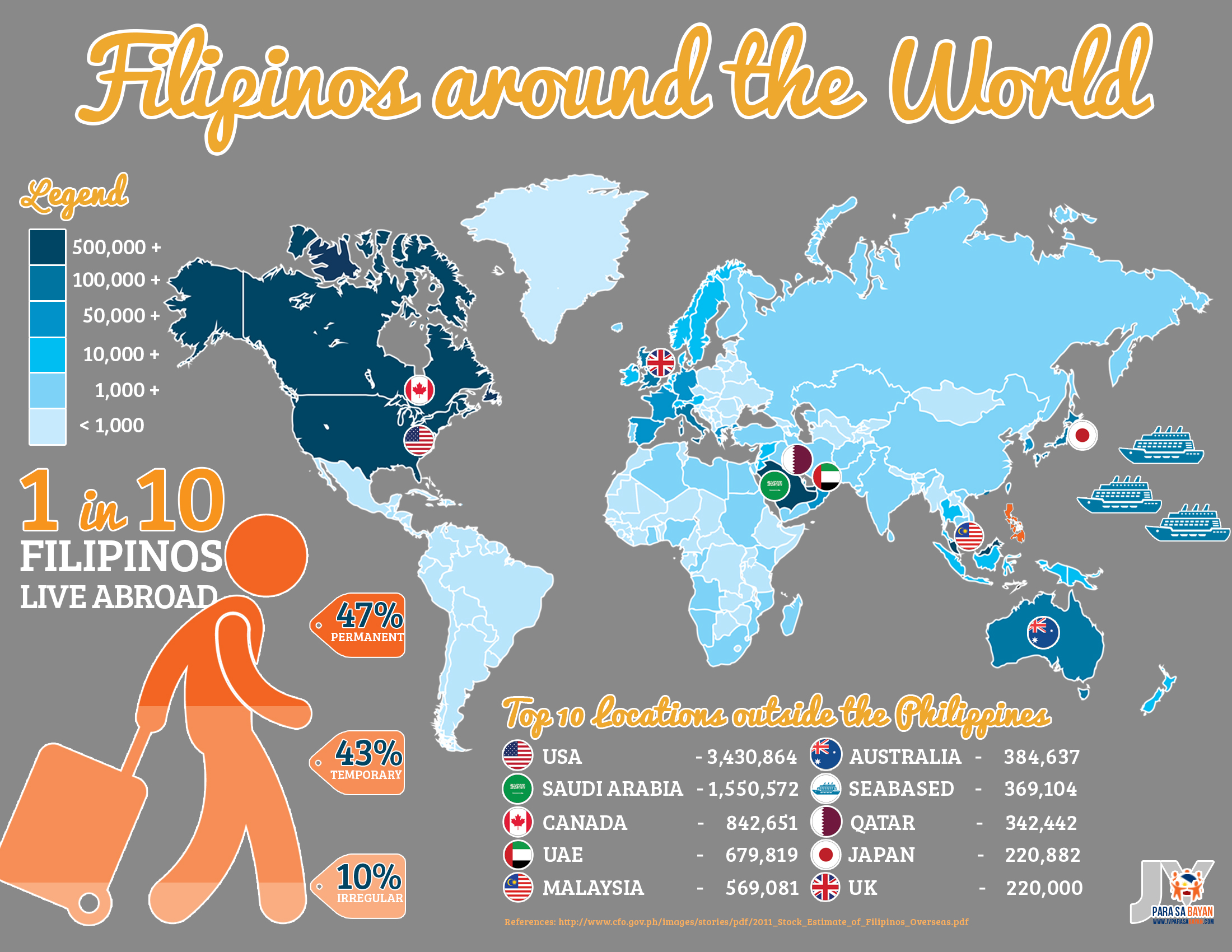
Tagalog can be found in Canada, Saudi Arabic, United Arab Estates, the
UK, Guam and the USA. World wide it is estimated that 24.2 million people
can speak Tagalog. In the US it is the sixth most spoken language, and is
considered the lingua franca of
Filipinos world-wide.
(Thompson, 2015)
(Admin, 2013)
Where in the US is Tagalog found
- estados unidos
Tagalog can be found in several
different states and cities as follows:
California: Greater
Los Angeles, San Francisco Bay Area, San Diego County, Daly City, Hercules,
Carson, Vallejo, Union City, National City, Milpitas, Delano, Cerritos,
Artesia, and Walnut.
Hawaii:
Kaumakani, Kunia, Lanai City, Papaaloa, Waipahu, Eleele, Ewa Beach, Kahului,
Lihue, Pahala, Waialua, Kekaha, Hanapepe, Pepeekeo, Kapolei, Kualapuu, Honokaa,
Kealia, Papikou, Makaweli. There were several more cities and towns that
consisted of a large percentage of Filipinos, but this is just a list of the
top 20%.
Illinois: Morton
Grove, Hoffman Estates, Glendale Heights, Skokie, Lincolnwood, and Great Lakes.
Alaska:
Akuton, King Cove, Stand Point, Dutch Harbor, Unalaska, Kodiak
New Jersey:
Bergenfield
(Team, ZipAtlas.com Development, 2017)
Jobs in the US that require Tagalog - trabaho
Business:
Customer Service:
Law:
Sales:
Healthcare:
Jobs in the US that require Tagalog - trabaho
Business:
- Recruiter for Therapeutic Gardens in Russell Gardens, NY
- Project Manager over Cargo Operations in Houston, TX
- Interpreter in Burlington, MA
- Financial Representative in Annandale, VA
- Cargo Superintendent in Houston, TX
Customer Service:
- Butler/ Houseman in Manhattan, NY
- Call Center Representative in Campbell, CA
Law:
- Legal Translator in San Diego, CA
- Social Services Advisor in Long Beach, CA
Sales:
- Regional Sales Director in San Bernardino, CA
- Solar Sales Consultant in Sacramento, CA
Healthcare:
- Greivance and Appeals Coordinator in San Francisco, CA
- Behavioral Health Care Advocate in San Diego, CA
- Family Practice Physician in Carson, CA
Resources:
"Tagalog: A History of the Language of the Philippines." Living Language. November 25, 2014. Accessed March 07, 2017. http://www.livinglanguage.com/blog/2014/11/25/tagalog-a-history-of-the-language-philippines/.
Admin, Author. "Category: philippine." Indie Filipino. July 15, 2013. Accessed March 13, 2017. http://www.indiefilipino.com/category/blog/philippine/.
Thompson, Irene.
"Tagalog ." About World Languages. September 27, 2015. Accessed
March 09, 2017. http://aboutworldlanguages.com/tagalog.
Team, ZipAtlas.com Development. "Cities with the Highest Percentage of Filipinos in the United States." Cities with the Highest Percentage of Filipinos in the United States | Zip Atlas. Accessed March 13, 2017. http://zipatlas.com/us/city-comparison/percentage-filipino-population.htm.
Tuesday, March 7, 2017
French

French- Français
History of the French Language- Histoire du français
French is descended from what is known as Vulgar Latin, the vernacular Latin of the Roman Empire. When ancient France, known as Gaul, was attacked and conquered by the Romans in the 2nd and 1st Centuries B.C., the residents in the region spoke Gaulish. Gaulish was a Celtic Language, but it was quickly replaced by Latin from the new Roman leaders. In the 5th Century A.D. Germanic tribes invaded Gaul, but they too were conquered and became Romanized. This is why we see German and Celtic roots in modern-day French.
By the 9th Century the area we know today as France boasted a language that was very different from Latin, making it its own language. This new language was known as Old French and was affluent from the 9th to the 13th Century. Dated in 842 AD is the Oaths of Strasbourg, the earliest text in Old French that is still around today. One of the various dialects of Old French, known as Francien and found in the north-central region including in Paris, became the standard form of the new French language because of the political and cultural importance of Paris. From the 14th to the 16th Century French was known as Middle French. From this time period several words and expressions were taken from Latin, Greek, and Italian. A group of French poets, the Pleiade, encouraged the French citizens to develop and improve their language and literature.
Modern French began in the 17th Century with the help of the French Academy. In 1635 the Academy was founded by Cardinal Richelieu in order to help maintain and uphold the purity of the language and its literature. It ultimately served as the ultimate judge of usage of the language. Although Romanticism and Realism have influenced the vocabulary and style of Modern French, structurally French has remained almost unchanged since the Middle French era. Standardization has been helped along by widespread education and mass media.
(History of French Language, 2012)
Where in the World is French - Où est le français
As of 2015, there are 29 independent nations where French is an official language. The following is a list of sovereign states and territories where French is an official or de facto language.
Those with French as an official language: France, Democratic Republic of Congo, Canada, Madagascar, Cameroon, Ivory Coast, Burkina Faso, Niger, Senegal, Chad, Guinea, Rwanda, Belgium, Burundi, Benin, Haiti, Switzerland, Togo, Central African Republic, Gabon, Republic of the Congo, Djibouti, Equatorial Guinea, Comoros, Luxembourg, Vanuatu, Seychelles, and Monaco.
Those with French as a de facto language: French Polynesia, New Caledonia, Aosta Valley, Jersey, Guernsey, Saint-Martin, Wallis and Futuna, Saint-Barthelemy, Saint-Pierre and Miquelon, French Southern and Antarctic Lands, and Pondicherry.
(List of Territorial Entities where French is an official language, 2017)

Where in the US is French spoken - États Unis
The following states and cities boast at least 10% of the population that can speak French:
Louisiana: St. Martin Parish, Evangeline Parish, Vermilion Parish, Lafourche Parish, Acadia Parish, Avoyelles Parish, Assumption Parish, St. Landry Parish, Jefferson Davis Parish, Lafayette Parish
Maine: Madawaska, Fort Kent, Van Buren, Frenchville, Eagle Lake, St. Agatha, St. Francis, Grand Isle, Saint John Plantation, Hamlin, Aroostook County, Androscoggin County
New Hampshire: Berlin, Coos County
(French language in the United States, 2017)
Jobs in the US that require French - Emplois
Customer Service:
- Representative for Dish in Flushing, NY
- Representative for Uline in Coppell, TX
- Help Desk Analyst in Schaumburg, IL
Communications:
- Technical Support in Salt Lake City, UT
- Customer Tech Support in Cottage Grove, WI
- Network Engineer in Atlanta, GA
- At-home Social Media Evaluator
Business
- Marketing and Administrative Assistant in Miami, FL
- Technical Publications Writer in Houston, TX
- Staff Buyer in Pittsburgh, PA
- Reimbursement Processor in Quad City Airport, IL
Education:
- Teacher in Houma, LA
- French/ ESL Teacher in New Hope, PA
- Curriculum Specialist in Columbus, OH
- Educational Director in Brooklyn, NY
Resources
"History of French Language." Infoplease. 2012. Accessed March 07, 2017. http://www.infoplease.com/encyclopedia/society/french-language-history-french.html.
"The French flag painted on grunge wall with bloody palmprint over it." Shutterstock.com. Accessed March 07, 2017. https://www.shutterstock.com/image-photo/french-flag-painted-on-grunge-wall-112409573.
"List of territorial entities where French is an official language." Wikipedia. February 19, 2017. Accessed March 07, 2017. https://en.wikipedia.org/wiki/List_of_territorial_entities_where_French_is_an_official_language.
"French language in the United States." Wikipedia. March 06, 2017. Accessed March 07, 2017. https://en.wikipedia.org/wiki/French_language_in_the_United_States.
"French Jobs." Monster. Accessed March 07, 2017. https://www.monster.com/jobs/search/?q=French.
Subscribe to:
Comments (Atom)