Spanish - Español
History of the Spanish Language - Historia del idioma español
 Originating in Southwest Europe, now known as the Iberian Peninsula, the regions first inhabitants began to mingle with the Celts at the end of the 6th Century BC. These two groups then formed a group called the Celtiberians, speaking a form of Celtic. When the Romans took over the region, it became known as Hispania, and its inhabitants were to learn Latin in order to deal with Roman traders,administrators, settlers, and soldiers. When classical Latin mixed with the language of the Celtiberians, Vulgar Latin came about. Although it followed the basics of Latin, this new language borrowed several words from other languages.
 Even after Germanic tribes invaded Hispanis in the 5th Century AD, Latin continued as the official language of the government and the culture until roughly 719 AD when Arabic- speaking Islamic groups, the Moors, from Northern Africa conquered the region. Arabic and its cousin Mozarabic spread throughout the region, taking over almost everywhere. Eventually the Christian Kingdoms in the region that survived the conquest, retook Moorish Spain, bringing back their Vulgar Latin and making it a part of the political, military, and cultural worlds. Vulgar Latin and its various dialects then spread as Christians began to move South.
Castilian was a dialect that originated on the North Central plains and was carried South and East. Castilian borrowed several words from Mozarabic, producing modern Spanish which has roughly 4000 words that have Arabic roots. Based on the Castilian dialect, King Alfonso X in the 13th Century began a standardized from of Spanish. Scholars wrote their original works in Castilian, and soon other works were translated into Castilian. Alfonso X himself used Castilian for administrative work, including all official documents and decrees.
 During the reign of the Catholic monarchs, Isabella of Castile and Ferdinand of Aragon, the Castilian dialect of Spanish was wider accepted. Ferdinand finished the reconquest of Spain in 1492, pushing out the Moors. It was then that Isabella and Ferdinand made Castilian the official language of the kingdom. Soon afterwards Antonio de Nebrija's book The Art of the Castilian Language appeared, becoming the first book that attempted to define the grammar of the Castilian language. The Castilian dialect then became the written and educational standard in Spain.
Starting in the 1400s, explorers, conquistadors, and colonizers from Spain traveled to Central, South, and parts of North America, taking their language and culture with them. Castilian was used in cultural centers such as Mexico City, Potosi, and Lima. These cities were closely linked to Madrid, but there was also the dialect of Andalusian. Many people from Andalucia explored as well, taking their dialect with them. This dialect became dominant in Argentina and Central America. These regions were remote, removed from the influence of Spain, cause the Spanish government to lose control. In the 1800's the colonies in America were lost, but the Spanish language stayed.
(Accredited, 2017)
Where in the World can Spanish be found - Donde se habla español
With 21 nations that have Spanish as an official language, it is easy to find spanish-speakers in the Americas and parts of Europe. Looking at only native speakers, about 400 million people are native Spanish-speakers, making it the 2nd most common language in the world.
Starting alphabetically, Spanish is found in Argentina, Bolivia, Chile, Colombia, Costa Rica, Cuba, Dominican Republic, Ecuador, El Salvador, Equatorial Guinea, Guatemala, Honduras, Mexico, Nicaragua, Panama, Paraguay, Peru, Puerto Rico, Spain, Uruguay, and Venezuela.
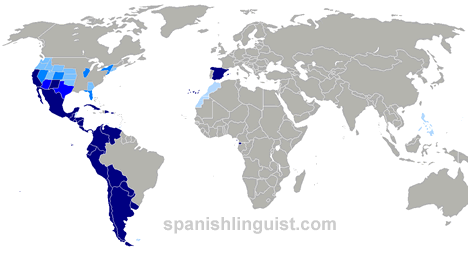
Due to the proliferation of the Spanish language in the US, being the 2nd most common language, it is a benefit to know Spanish when looking for literally any job or position. Spanish is so common in the US that some towns have more signs in Spanish then they do in English.
Resources
Accredited. "Spanish." Accredited Language Services. Accessed March 27, 2017. https://www.alsintl.com/resources/languages/Spanish/.
GmbH, Lesson Nine, and Babbel.com. "The 10 Most Spoken Languages in the World." The Babbel Magazine. Accessed March 27, 2017. https://www.babbel.com/en/magazine/the-10-most-spoken-languages-in-the-world.
Beus, Jake. "Learn." LearnALanguage.com. October 4, 2012. Accessed March 27, 2017. http://www.learnalanguage.com/blog/spanish-speaking-countries/.
"Espana - Spain spanish text - vintage card - poster vector illustration, spanish flag colors, grunge effects can be easily removed." Shutterstock.com. Accessed March 27, 2017. https://www.shutterstock.com/image-vector/espana-spain-spanish-text-vintage-card-303945407.
"List of Spanish-speaking Countries by Population." Spanish Linguist. Accessed March 27, 2017. http://www.spanishlinguist.com/extra/spanish_speaking_countries_world_figures_and_map.html.

No comments:
Post a Comment