Arabic - عربى
History of the Arabic Language-
History of the Arabic Language-
The Arabic that we know today descends from a single a military koine that came about during the Islamic conquests. The modern dialects were a direct result of these conquests. The dialects contain many layers of borrowed features, insteading just emerging as a single or multiple koines. These layers were absobed at different points and locations in history.
At the end of the 6th Century, a uniform, intertribal koine was developed but it was distinct from those koines based on the Bedouin dialects of Najd. The word "Arab" means "nomad", pointing to the origins of Arabic coming from nomadic tribes in the Arabian Peninsula (Arabic, 2017).
Starting at the turn of the 7th Century, the Islamic Conquest brought speakers of diverse Arabic dialects into all of the Middle East and North Africa. These speakers also brought their Islamic religion and specific Arabic language and customs. These conquerers went all the way west into the Iberian Peninsula and east all the way to China. As the traveling Arabs married with the locals in the Middle East and North Africa, the Arabic language became the prominent language to dominate the regions.
Some of the native languages, such as Berber (found in Algeria and Morocco), Kurdish (in Iraq and Syria), Jabali (in Oman), and Mahri (in Yemen) are still found in these areas to this day. Yet some other languages have seen a decrease in native speakers. One language for example is Aramaic, the language that was most widely spoken in the Middle East before the Conquests, can still be found in small pockets in Syria and Iraq. Coptic in Egypt was the most common language there, being a direct descendant of Ancient Egyptian, but now only survives as remaining the liturgical language of the Coptic Church. (Arabic Without Walls, 2017)
Due to the contact of Arabic with other languages, many other languages can trace words and word-roots back to Arabic origins. Persian and Turkish are filled with Arabic words, while the actual language name of "Swahili" is an Arabic world. Arabic has been presevered in writing through the Prophet Muhammad's revelations recorded in the Qur'an. (Arabic, 2017)
At the end of the 6th Century, a uniform, intertribal koine was developed but it was distinct from those koines based on the Bedouin dialects of Najd. The word "Arab" means "nomad", pointing to the origins of Arabic coming from nomadic tribes in the Arabian Peninsula (Arabic, 2017).
Starting at the turn of the 7th Century, the Islamic Conquest brought speakers of diverse Arabic dialects into all of the Middle East and North Africa. These speakers also brought their Islamic religion and specific Arabic language and customs. These conquerers went all the way west into the Iberian Peninsula and east all the way to China. As the traveling Arabs married with the locals in the Middle East and North Africa, the Arabic language became the prominent language to dominate the regions.
Some of the native languages, such as Berber (found in Algeria and Morocco), Kurdish (in Iraq and Syria), Jabali (in Oman), and Mahri (in Yemen) are still found in these areas to this day. Yet some other languages have seen a decrease in native speakers. One language for example is Aramaic, the language that was most widely spoken in the Middle East before the Conquests, can still be found in small pockets in Syria and Iraq. Coptic in Egypt was the most common language there, being a direct descendant of Ancient Egyptian, but now only survives as remaining the liturgical language of the Coptic Church. (Arabic Without Walls, 2017)
Due to the contact of Arabic with other languages, many other languages can trace words and word-roots back to Arabic origins. Persian and Turkish are filled with Arabic words, while the actual language name of "Swahili" is an Arabic world. Arabic has been presevered in writing through the Prophet Muhammad's revelations recorded in the Qur'an. (Arabic, 2017)
Common
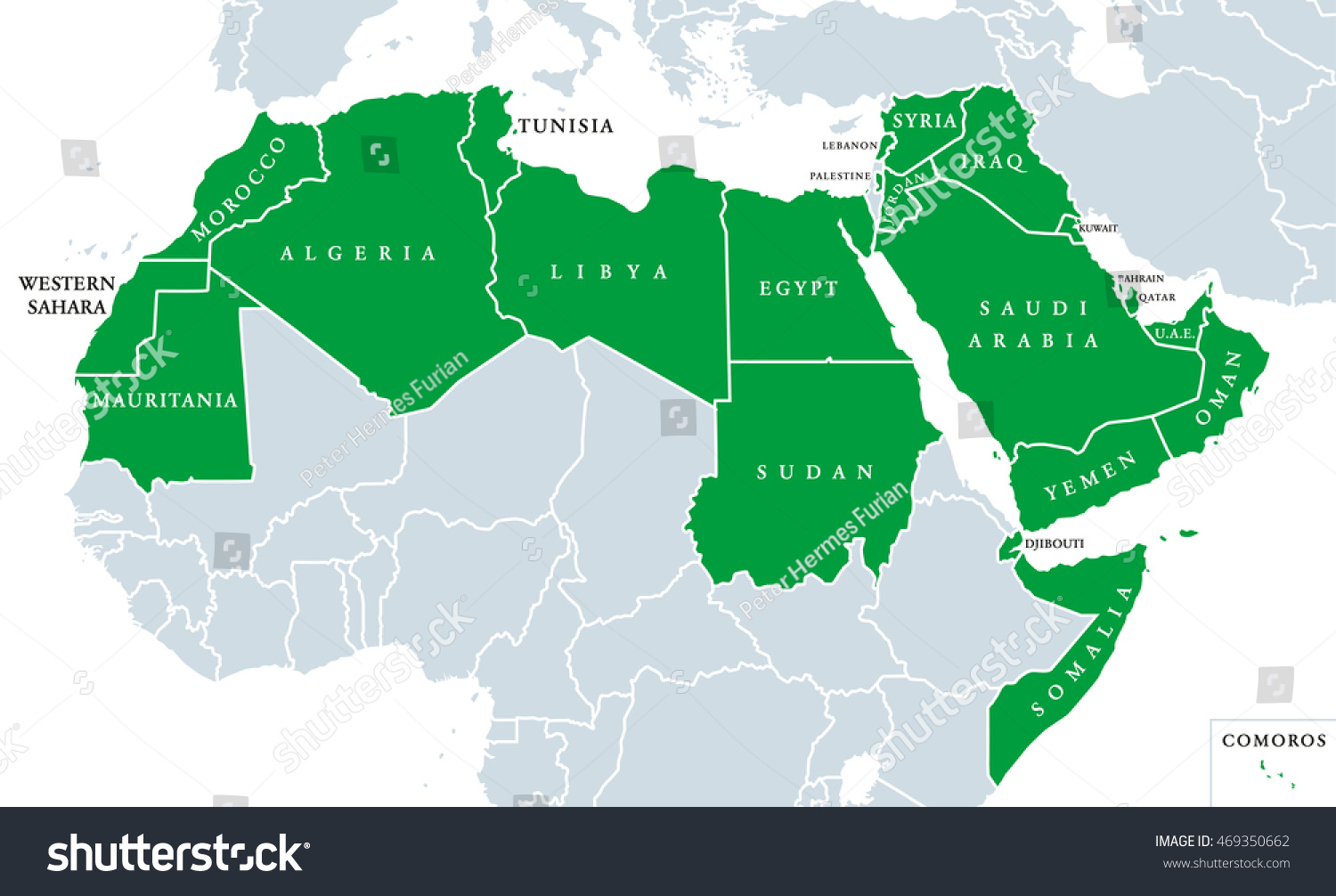
Areas that Arabic is Spoken in the World-
Arabic is
considered, in its standard form and dialects, a single language. The
following countries have Arabic as an official language:
Algeria,
Bahrain, Egypt, Iraq, Jordan, Kuwait, Lebanon, Libya, Mauritania, Morocco,
Oman, Palestine, Qatar, Saudi Arabia, Sudan, Syria, Tunisia, United Arab
Emirates (UAE), Yemen
Arabic
as found in the United States-
The Arabic
language is the fastest-growing foreign language taught at U.S. colleges
and universities.
Arabic in
2006 became the 10th most-studied language in the United States.
In 2013,
Arabic was ranked the 8th place on the list of enrollments in higher education
in the USA.
Within the
US California ranks #1 for the most Arabic speakers, with
158,398 speakers at the 2010 census. Some of the cities include Los Angeles,
San Francisco, San Bernidino, Arcadia, Cupertino, El Cajon, Dublin, Santa
Monica, and Anaheim.
Michigan comes in second with 101,470, the major cities being Grand Rapids, Southfield, Wayne, Decatur, Ann Arbor, Dearborn, Dearborn Heights Detroit, Warren, Milford, and Sterling Heights.
New York boasts Arabic speaking cities including New York, Manhattan, Buffalo, Garden City, Long Island, Elmhurst, Jamaica, Flushing, and Brooklyn.
Texas comes in 4th as having the most Arabic speakers. Main cities include Dallas, Houston, Plano, University City, San Antonio, Hunstville, McAllen, Austin, Grand Prairie, and Richardson.
Illinois cities include Chicago, False, Deerfield, Evanston, Villa Park, Brookfield, Oak Lawn, La Grange, Hinsdale, Westmont, Oakbrook Terrace, and York Center.
New Jersey cities include Jersey City, Elizabeth, Summit, Paterson, Morristown, and Elmwood Park.
Virginia cities are Fairfax, Alexandria, Seven Corners, Reston, Falls Church, Classified, Lorton, Baileys Crossroads, Vienna, Herndon, Williamsburg, and Chantilly.
Florida cities are Orlando, Tampa, Ft. Myers, West Palm Beach, MacDill AFB, Panama City, and Miami.
Ohio includes Columbus, Cleveland, Continental, London, Independence, Jeruselam, Dayton, and Brooklyn.
(Arabic Language in the United States, 2016)
Examples
of Jobs in the United States requiring Arabic -
Customer Service:
- Concierge at a Hotel in Queens
- Customer Service Executive in Plano, TX
- Sales Manager, Hutto, TX
- Call Center in Queens, NY
- Waiter in Jamaica, NY
- Community Events Coordinator, Wenatchee, WA
Healthcare:
- Take calls regarding Healthcare questions in Plano, TX
- Chemical Dependency Counselor, Buffalo, NY
- Internist Physician, Woburn, MA
Intelligence:
- Intelligence Operator in McLean, VA
- Archives Digitization Assistant, Washington D.C.
- Jr Cyber Intelligence Analyst, University Park, TX
- Internet Researcher, Product Classification Analyst, Pittsburgh, PA
Teaching:
- World Language Instructor, Tacoma, WA
These jobs were found on
Monster.com and are only a portion of what was available
Bibliography
- "Arab World political map, also called Arab nation, consists of twenty-two arabic-speaking countries of the Arab League. All nations in green color, plus Western Sahara and Palestine. English labeling." Shutterstock.com. Accessed March 02, 2017. https://www.shutterstock.com/image-vector/arab-world-political-map-called-nation-469350662.
- "Arabic." Wikipedia. January 15, 2017. Accessed January 31, 2017. https://en.wikipedia.org/wiki/Arabic#History.
- "Arabic language in the United States." Wikipedia. November 8, 2016. Accessed January 31, 2017. https://en.wikipedia.org/wiki/Arabic_language_in_the_United_States.
- Ridout, Scott. "Arabic Speaking Countries List - 2017." IstiZada. 2015. Accessed January 31, 2017. http://istizada.com/complete-list-of-arabic-speaking-countries-2014/.
- "Arabic Jobs." Monster. Accessed March 02, 2017. https://www.monster.com/jobs/search/?q=Arabic.
- "Arabic Without Walls." Arabic Without Walls. Accessed March 06, 2017. http://arabicwithoutwalls.ucdavis.edu/aww/alifbaa_unit1/ab1_culture_history.html.

No comments:
Post a Comment